 MrGripper
The short answer
To build grip strength for BJJ, train two qualities: hard closing force for securing a grip and isometric endurance for keeping it while your opponent strips, pulls, and changes angle. Use gi- or towel-based holds, track duration and rest, test both hands separately, and progress one variable at a time without compromising mat work.
The grip that wins the first exchange is not always the grip that survives the third.
That is why a bigger hand-gripper number is only part of the answer. In gi BJJ, your fingers must close around fabric, your forearms must hold tension without a clean rest, and both hands must keep doing their jobs as the exchange changes. Max strength matters. So does the ability to repeat and sustain it.
The useful question is not simply “How strong is my grip?” It is: Which grip quality fails first, under what conditions, and on which side?
What kind of grip strength matters for BJJ?
Use this as a practical model rather than a set of perfectly separate categories:
| Quality | What it looks like in gi BJJ | Useful training measure |
|---|---|---|
| Closing force | Clamping fingers around a sleeve, lapel, or trouser grip | Heavy gripper or dynamometer result per hand |
| Gi hold endurance | Keeping fabric closed in the hand while force and angle change | Timed gi or towel hold |
| Repeat-grip endurance | Re-gripping after a break, transition, or failed exchange | Completed work intervals at a fixed work:rest ratio |
| Left–right capacity | Both hands remaining useful instead of one side carrying the exchange | Same test, setup, and rest for each hand |
These qualities overlap, but they are not interchangeable. A dynamometer gives you a repeatable measure of maximal handgrip force. A gi hang asks whether you can maintain a fabric grip while supporting load. A gripper trains closing force, but it does not reproduce the thickness, friction, wrist position, or changing angle of an opponent’s gi.
Train the general quality, then make part of the work look like the sport.
Why does gi grip endurance deserve its own test?
Because BJJ research does not treat a bare-handle squeeze as the whole story.
A study of 15 experienced male BJJ athletes—eight brown belts and seven black belts—measured both dynamometer handgrip strength and a maximum static suspension while gripping a kimono. The group averaged 53 ± 7 kgf in the dominant hand, 50 ± 9 kgf in the non-dominant hand, and 30 ± 14 seconds in the kimono suspension.
Those numbers are not standards for you to beat. The sample was small, male, and highly experienced. The important point is the test selection: the researchers measured maximal hand strength and gi-specific endurance as different outcomes.
A systematic review of BJJ athletes reached a similar practical conclusion: gi-specific isometric grip-endurance tests could distinguish athletes with different experience and competitive levels. That does not prove grip endurance alone wins matches. It does make a strong case for measuring more than one maximal squeeze.
Does the strongest athlete always have the best BJJ grip?
No single grip number can answer that.
Maximal force gives you a ceiling. Endurance determines how much useful force remains after repeated work. Technique and grip economy determine how much of that force you waste. BJJ performance still depends on timing, position, leverage, and tactical choices—not forearms in isolation.
The fatigue evidence also needs honest limits. A systematic review of repeated combat-sport matches found that upper- and lower-limb performance declined in grappling sports, with BJJ athletes showing an earlier onset of fatigue in the included studies. But none of the 13 studies in that review used a randomized controlled design, and none was rated high quality.
The defensible takeaway: fatigue can reduce measured grip performance during repeated grappling efforts, but research does not give every BJJ athlete one perfect grip program. Keep your plan measurable, specific enough to transfer, and small enough not to damage technical training.
How should you test BJJ grip strength?
Use one general test and one gi-specific test. Run them fresh, not after hard rounds, and repeat the same setup when you retest.
Test 1: maximal handgrip force per hand
Use a dynamometer if you have one.
- Keep the device, handle position, posture, warm-up, and instructions the same.
- Test left and right separately.
- Take three hard attempts per hand with enough rest to avoid turning the test into endurance work.
- Record the best clean reading for each side and the full attempt history.
- Compare future results only when the setup matches.
For a detailed standardized setup, use the home grip-strength testing protocol. A dynamometer score is useful because it is easy to repeat; it is not a direct simulation of holding a gi.
Test 2: gi or towel hold endurance
Use a securely anchored gi or thick towel. Choose a version you can perform with stable shoulders and elbows: a feet-assisted hold, a loaded row hold, or a suspended hold if that position is already familiar and controlled.
- Fix the fabric, fold, hand position, elbow angle, and body position.
- Start the timer when the full working position is established.
- Stop when the grip opens or the agreed position changes.
- Record duration, hand configuration, assistance or load, and why the attempt ended.
- Keep that exact standard for the next test.
Do not compare a thin towel with a doubled gi lapel as if they were the same test. Fabric thickness and setup change the task.
What is a practical two-day BJJ grip routine?
The following is a starting template for a healthy adult practitioner, not a research-validated prescription. Put it after technical or strength work—not before the rolling session you care about—and reduce it when gi rounds already leave your hands heavily fatigued.
Day A: closing strength and controlled gi holds
- Heavy gripper closes or dynamometer-style squeezes: three to four sets of four to six controlled efforts per hand. Stop before technique turns into wrist movement.
- Gi or towel hold: three to four sets of 15–30 seconds using a load or assistance that lets you keep the agreed position.
- Single-hand row hold: two to three sets of 10–20 seconds per side with the same fabric and load.
Rest long enough that strength sets stay strong. The goal is not to create the largest forearm pump possible. It is to produce repeatable work you can progress.
Day B: repeat-grip endurance
- Choose a gi, towel, or gripper resistance you can hold cleanly when fresh.
- Perform six rounds of 10 seconds working and 20 seconds resting per hand or grip position.
- Rest two to three minutes, then repeat for two to three total sets if the first set stayed technically consistent.
- Stop when you can no longer close the fabric or hold the agreed wrist and elbow position.
The 10-second work and 20-second rest structure mirrors a published handgrip endurance test used with young judo athletes; it is borrowed here as a measurable interval, not claimed as a validated BJJ training prescription.
If your academy week already includes several hard gi sessions, one short dedicated grip session may be enough. Your mat work is part of the grip workload, even when it is not written in the gym program.
How do you progress without burning out your hands?
Progress one variable at a time:
- add two to five seconds to a hold;
- add a small amount of load;
- use slightly less assistance;
- complete one more clean interval; or
- keep the work fixed and shorten rest slightly.
Do not increase load, duration, interval count, and gi difficulty in the same week. If the result improves, you will not know why. If your elbows or fingers become irritated, you will not know which change exceeded your current capacity.
Use the mat as the final test. A better hold time is useful only if you can still hand-fight, frame, pull, and make decisions without arriving at class with exhausted forearms.
Why track left and right separately?
Because “both hands completed the set” does not tell you whether both hands did equal work.
The experienced athletes in the 2016 BJJ study had similar mean dynamometer results between dominant and non-dominant hands, but that group average cannot tell you how your hands compare. Your preferred sleeve hand, lapel hand, guard side, prior injuries, and technical habits are individual.
For every unilateral test or exercise, record:
- hand;
- exercise and equipment;
- fabric setup or gripper resistance;
- load or assistance;
- hold time or completed intervals;
- work:rest ratio;
- whether the grip opened, the position changed, or another muscle group failed first; and
- any pain or unusual symptoms.
Calculate a left–right gap only from the same test conditions. The grip-strength symmetry guide explains how to compare sides without turning one test into a diagnosis.
What are the most common BJJ grip-training mistakes?
Training only crush strength
Closing a harder gripper is measurable and satisfying. It still does not prove you can hold a sleeve through a long exchange. Keep some heavy closing work, then include fabric-based isometric work.
Turning every set into a maximum
Maximal efforts are difficult to repeat and recover from. Most of the routine should have a clear stop rule and enough margin to preserve position.
Adding grip work without counting gi rounds
Hard sparring, grip-fighting drills, pull-ups, rows, carries, and dedicated forearm work all draw from the same weekly recovery budget. The label on the session does not change what your hands experienced.
Comparing different setups
A longer hold on thinner fabric, with more assistance or a different elbow angle, is a different result. Log the setup, not just the time.
Treating pain as a conditioning problem
Forearm fatigue during a hard set is not the same as sharp finger, wrist, or elbow pain. Stop painful work and get qualified assessment when symptoms persist, worsen, or change how you grip. This guide is training information, not injury diagnosis or rehabilitation advice.
How do you track BJJ grip work in MrGripper?
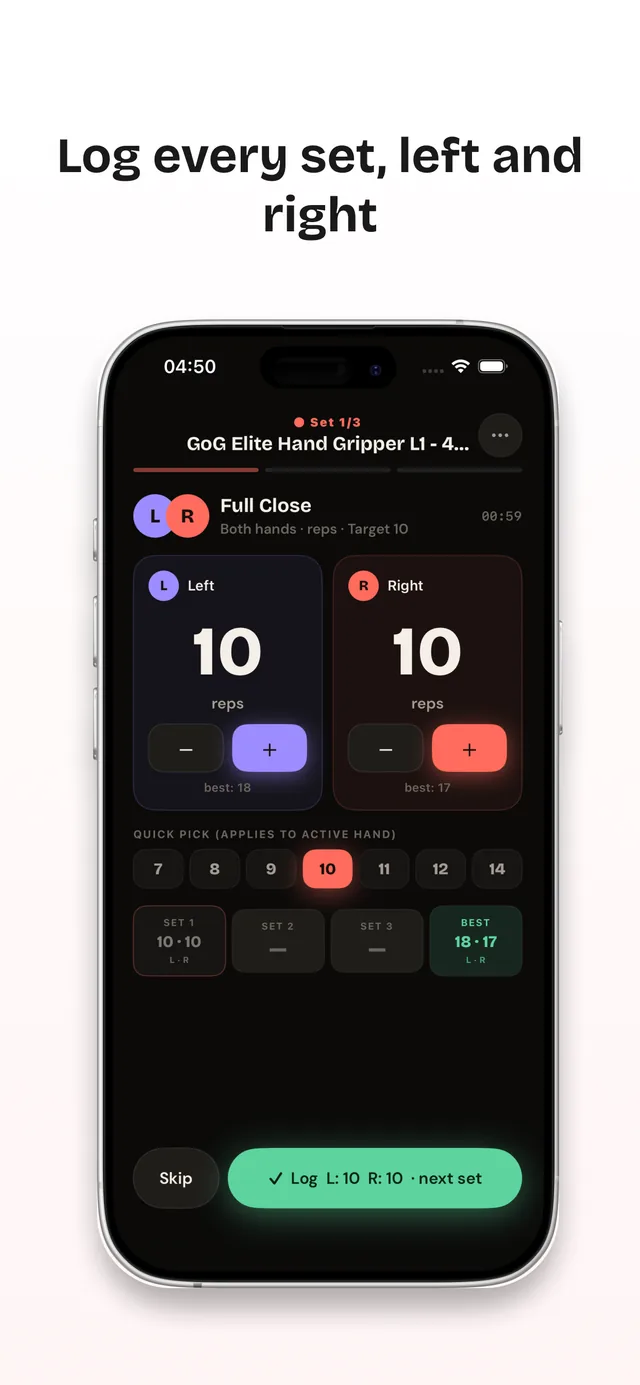
MrGripper keeps the variables that generic workout logs tend to merge:
- log reps or timed holds with a built-in timer;
- record left, right, or both hands;
- save a gi, towel, gripper, or other tool in the gear library;
- track load volume and hold time; and
- keep PRs tied to the exercise, equipment, load, and hand.
The free tier includes unlimited workouts and custom exercises, per-hand tracking, timed holds, dynamometer tests, weekly insights, 30-day history, and up to five equipment pieces. Readings are entered manually, so you can use the dynamometer or grip gear you already own—no proprietary Bluetooth device is required.
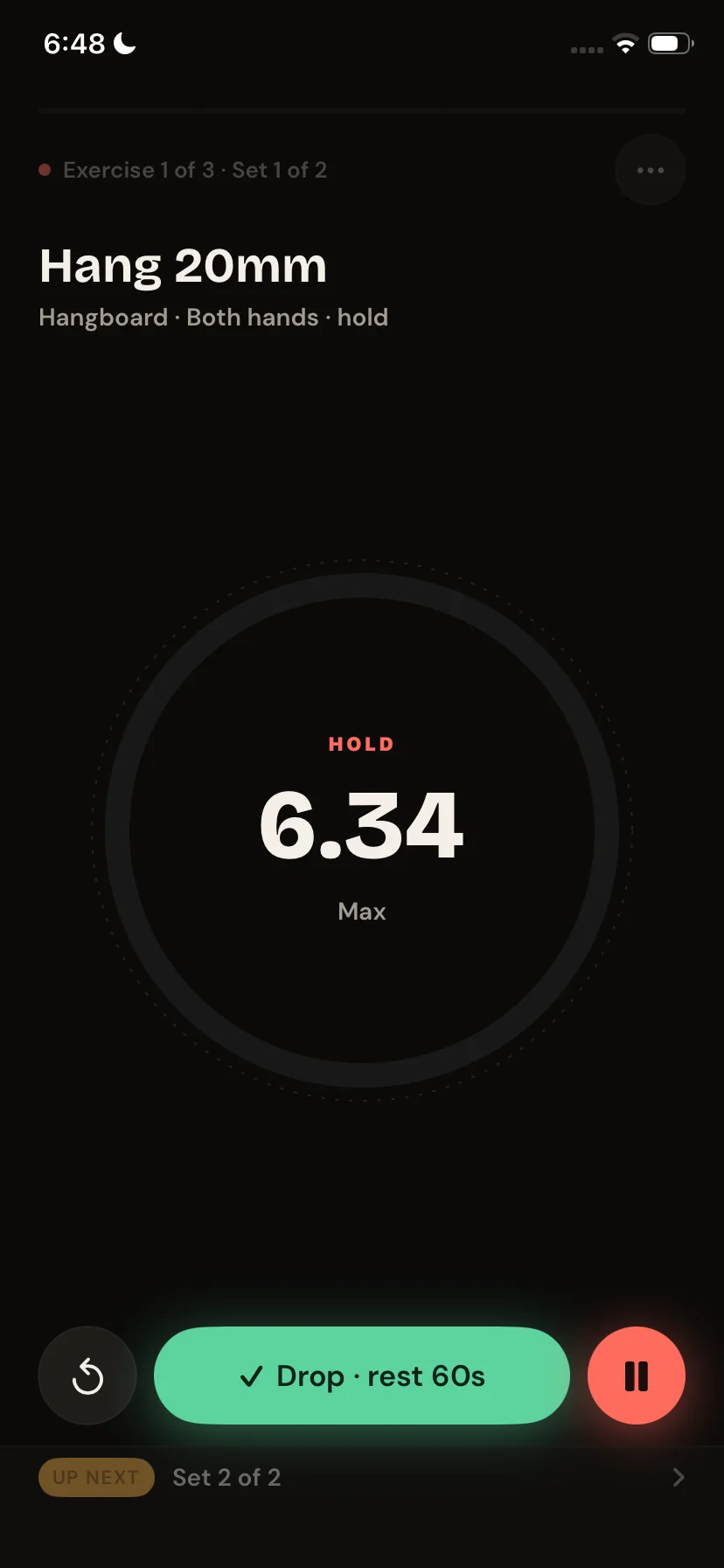
Track every hold, hand, and rest interval
Grip Strength: MrGripper is free on the App Store—log timed gi or towel holds against the equipment, load, and hand that produced them.
Frequently asked questions
Are hand grippers good for BJJ?
They can build and measure closing force, but they do not reproduce a gi grip by themselves. Pair gripper work with timed gi or towel holds so the program includes closing strength and fabric-specific endurance.
How often should I train grip for BJJ?
Start with one or two short sessions per week and count hard gi training, pulling work, and carries as part of the total hand and forearm load. Reduce dedicated work if grip quality stays flat during technical practice or sparring.
Should I train grip before or after BJJ?
Usually train grip after the session you care about. Fatiguing your hands first can reduce the quality of technical drilling or hard rounds. A separate session can work when recovery and total weekly load are controlled.
How can I improve gi grip endurance at home?
Anchor an old gi or sturdy towel safely, choose a repeatable assisted hold or row-hold position, and record work time, rest, load, and hand. Progress one variable at a time. Do not suspend your full body weight unless the anchor and your position are secure and the exercise is already appropriate for you.
Does no-gi BJJ need the same grip training?
No-gi still demands hand and forearm strength, but the positions differ because you control wrists, hands, limbs, and body contours instead of fabric. General closing and holding work can carry over, while gi hangs should not dominate a no-gi-specific plan.
Sources
- Andreato LV, et al. Physiological, Nutritional and Performance Profiles of Brazilian Jiu-Jitsu Athletes. Journal of Human Kinetics. 2016.
- Andreato LV, et al. Physical and Physiological Profiles of Brazilian Jiu-Jitsu Athletes: a Systematic Review. Sports Medicine - Open. 2017.
- Kons RL, Orssatto LBR, Detanico D. Acute performance responses during repeated matches in combat sports: A systematic review. Journal of Science and Medicine in Sport. 2020.
- Honorato RDC, et al. Differences in Handgrip Strength-Endurance and Muscle Activation Between Young Male Judo Athletes and Untrained Individuals. Research Quarterly for Exercise and Sport. 2021.