 MrGripper
The short answer
Climbers build grip most directly with structured fingerboard work: weighted or assisted hangs for maximal finger force, intermittent hangs for strength-endurance, and pinch work for thumb-led grips. Count hard climbing in the same weekly load, keep the test conditions fixed, and track each hand separately—two-handed hangs can improve while one side still does more of the work.
A longer hang is not automatically a stronger grip. If you changed the edge, grip position, assistance, rest time, or how much work each hand contributed, you changed the test. The stopwatch still gives you a number; it just does not tell you what improved.
The fix is not a more complicated fingerboard plan. It is a repeatable plan with fewer moving parts and records that preserve the difference between your left and right hand.
What grip strength matters for climbing?
Climbing asks for at least three related qualities:
- Maximal finger force: how much force you can apply to an edge for a short effort.
- Finger strength-endurance: how well you repeat or sustain submaximal efforts as fatigue builds.
- Pinch strength: how well your fingers and thumb oppose each other on pinches and volumes.
These qualities overlap, but they are not interchangeable. A bar dead hang measures support endurance on a large round handle. A gripper measures crush strength. Neither reproduces the hand position or edge depth of a half-crimp on a fingerboard.
That specificity appears in training research. In a randomized study of 35 intermediate-to-advanced climbers, a 10-week fingerboard program performed twice weekly improved peak and average force on a 23 mm rung more than normal climbing alone. Dead-hang duration improved within the training group, but the change was not significantly different from the control group—evidence that finger force and hang endurance should not be treated as the same outcome.
Are weighted hangs or smaller edges better?
For strength, a fixed edge with gradually added weight is easier to measure than a constantly shrinking edge. It also has direct experimental support.
An 8-week randomized trial assigned 30 intermediate-to-advanced climbers to normal climbing, progressively smaller edges, or progressively added weight. The added-weight group improved overall measured grip strength more than the control group; the smaller-edge group did not show the same overall advantage.
That does not prove small-edge training is useless. It means the added-weight protocol produced the clearer strength result in this study. For your own training, choose one main progression variable:
| Goal | Main method | Keep fixed | Track |
|---|---|---|---|
| Maximal finger force | Short weighted or assisted hangs | Edge depth, grip, hang time, rest | Total system load or assistance |
| Strength-endurance | Intermittent hangs or repeaters | Edge, grip, work:rest ratio, repetitions | Completed work and form quality |
| Pinch strength | Single-hand pinch-block holds or lifts | Block width, grip position, hold time | Load or hold time for each hand |
If you make the edge smaller, add weight, change grip position, and shorten the rest in the same block, you will not know which change caused the result.
How should you use max hangs and repeaters?
Use max hangs when your main limitation is short, high-force contact on edges. Use repeaters when you can do the moves fresh but lose the ability to apply force after repeated efforts. You do not need both at full volume in every session.
Research does not identify one universal protocol for every climber. It does support two practical principles:
- Train the quality you want to improve. Short, high-load efforts emphasize maximal force; intermittent work accumulates more time under tension.
- Run a stable block. Keep the edge, grip, timing, and rest consistent long enough to compare like with like.
Published studies include formats such as repeated 7-second hangs with 3-second rests, and 10-second maximum hangs separated by several minutes. Those are descriptions of research protocols—not a prescription for your body or climbing week. Training history, current climbing load, age, symptoms, and access to coaching should determine whether and how you use them.
Count the whole week. Hard bouldering, board climbing, limit crimping, campus work, fingerboarding, and pinch training all add finger load. Add dedicated work only when you are recovering between sessions and can keep the agreed grip position without pain.
Why should climbers track each hand separately?
Because a two-handed result hides force sharing.
In a study of 36 advanced and elite male climbers, the strongest hand produced 4.1% more maximal isometric finger-flexor force on average than the weaker hand. Climbing style and ability level did not explain the difference.
Treat 4.1% as context, not a pass/fail line. The sample was small, male, and experienced. The useful lesson is that bilateral differences exist even among strong climbers—and your writing hand is not a substitute for measuring both sides.
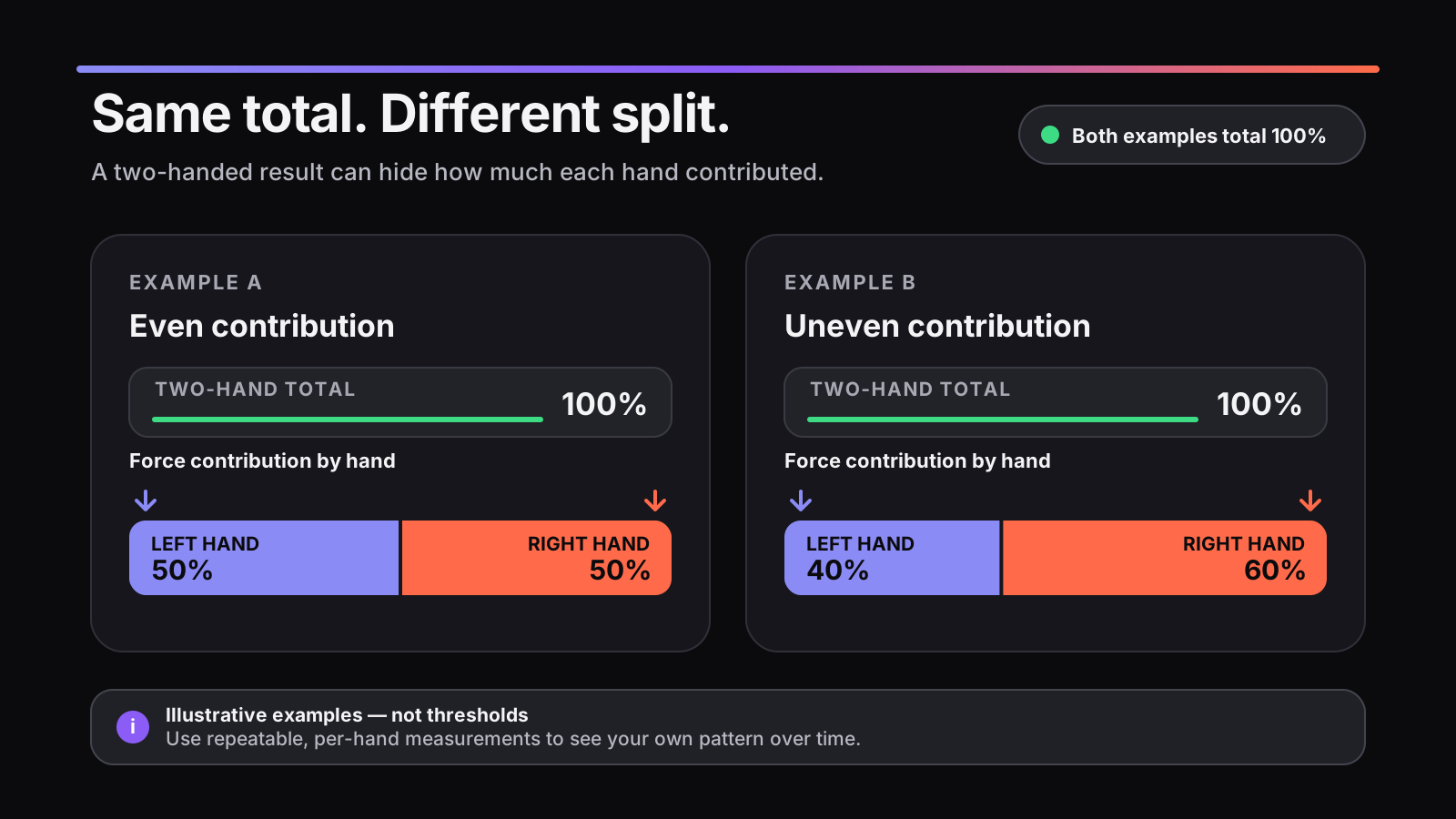
For a repeatable per-hand check:
- Use the same edge, grip position, body position, and warm-up.
- Use a pulley, resistance band, or feet-on-scale setup if a full one-arm hang is not controlled.
- Record the peak repeatable load or lowest assistance for each hand. Do not turn the test into an unsupported one-arm maximum attempt.
- Calculate the gap as
(stronger − weaker) ÷ stronger × 100. - Re-test after a training block, not after every session.
The number is a training signal, not a diagnosis. If one side changes suddenly, hurts, or loses force without an obvious training explanation, stop testing and speak with a clinician who understands climbing injuries.
How do you train and measure pinch strength?
Pinch blocks make per-hand measurement straightforward because one hand works at a time. But block width matters: a wider pinch changes the thumb and finger position, so a 20 kg lift on one block is not directly comparable with 20 kg on another.
Choose one block and record:
- hand;
- block width or equipment name;
- load;
- hold duration or rep standard;
- sets and rest;
- whether the attempt was clean or slipped.
Use holds if you want a simple timed progression. Use controlled lifts if load is the main variable. In either case, progress load or duration, not both at once.
How do you manage fingerboard load without guessing?
Your fingers do not know which app or training plan a session came from. They experience the combined load from climbing, bouldering, board sessions, fingerboard work, and pinch training.
A one-year prospective cohort of 426 recreational indoor climbers found that the finger was the most frequent upper-extremity injury location, accounting for 36% of recorded injuries. Previous injury and campus-board use were among the factors associated with higher injury risk. Association is not proof that one session caused an injury, but it is a reason to count all hard finger loading together.
| Date | Session | Hard finger sets | Edge or grip | Load | Notes |
|---|---|---|---|---|---|
| Mon | Limit bouldering | 8 | Mixed | n/a | High intensity |
| Thu | Max hangs | 5 | 20 mm half-crimp | +5 kg | Five clean hangs |
| Sat | Routes | 6 hard attempts | Open/mixed | n/a | Forearms fatigued |
The UIAA Medical Commission recommends gradual increases in training, enough recovery for adaptation, and a training diary to connect volume and intensity with symptoms. It also advises climbers not to ignore pain and to seek an appropriate diagnosis for suspected injury.
Stop the session for sudden sharp pain, a pop, swelling, or a clear loss of function. Do not use this article to diagnose a pulley or tendon injury.
What should you record after every hang session?
At minimum:
- exercise and equipment;
- edge depth or pinch-block width;
- grip position;
- hand: left, right, or both;
- body weight plus added weight, or assistance removed;
- hang duration and work:rest ratio;
- sets completed;
- effort and any symptoms.
The rule is simple: if changing a variable would make the next result incomparable, record it.
MrGripper is built around this data shape. You can add a hangboard or pinch block to the gear library, log timed holds with the built-in timer, choose left, right, or both hands, and keep PRs tied to the exercise, equipment, load, and hand. The free tier includes per-hand workout tracking, the timer, custom exercises, and up to 5 equipment pieces.
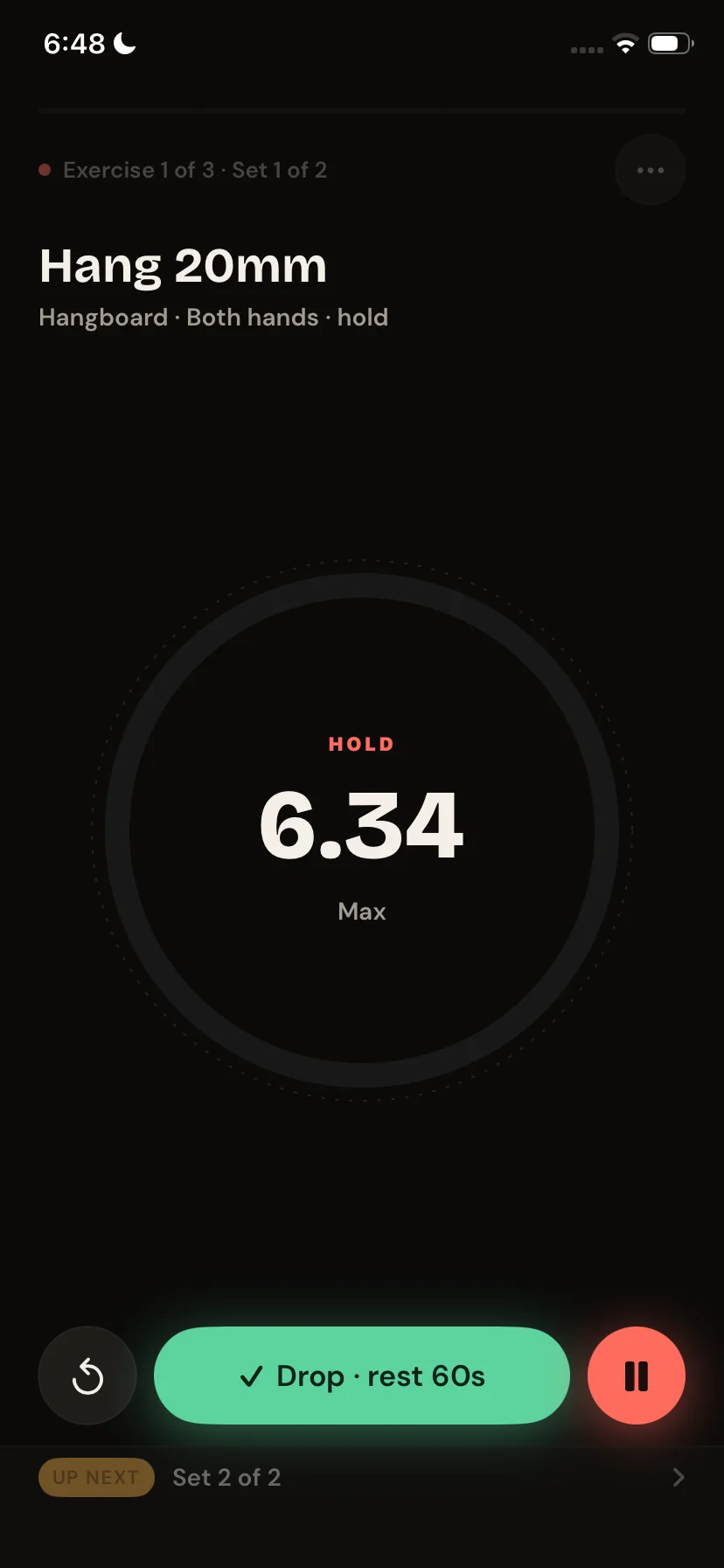
Track the variables that make a hang comparable
Grip Strength: MrGripper is free on the App Store—log timed holds, equipment, load, and hand against your own history.
Frequently asked questions
How often should climbers train grip off the wall?
Start with one dedicated finger session per week if you already climb hard. Two weekly sessions appear in controlled studies, but total climbing and fingerboard load, recovery, training history, and symptoms matter more than copying a frequency in isolation.
Are max hangs or repeaters better for climbing?
Max hangs are the more direct choice for maximal finger force. Repeaters accumulate intermittent work and align more closely with strength-endurance. Choose the method that matches your limiter and keep the edge, grip, timing, and rest stable.
Should a beginner use a hangboard?
New and lower-grade climbers can build substantial finger capacity through climbing. If you cannot load a fingerboard with stable shoulder, elbow, and grip positions, use easier climbing and coached technique work first. Adolescents and anyone returning from finger pain should get qualified guidance before maximal finger loading.
How do I compare left- and right-hand finger strength?
Use an assisted one-arm test on the same edge and grip position for both hands. Keep the warm-up, body position, assistance, rest, and scoring rule the same, then compare repeatable efforts rather than uncontrolled maximum attempts.
Do grippers improve climbing grip?
Grippers train crush strength, but they do not reproduce edge, open-hand, half-crimp, or pinch positions. If climbing performance is the goal, climbing-specific holds should provide the specific part of your grip training.
Sources
- Hermans E, et al. The Effects of 10 Weeks Hangboard Training on Climbing Specific Maximal Strength, Explosive Strength, and Finger Endurance. Frontiers in Sports and Active Living. 2022.
- Mundry S, et al. Hangboard training in advanced climbers: A randomized controlled trial. Scientific Reports. 2021;11:13530.
- Hartley C, et al. Handedness, Bilateral, and Interdigit Strength Asymmetries in Male Climbers. International Journal of Sports Physiology and Performance. 2023;18:1390–1397.
- Saeterbakken AH, et al. The Connection Between Resistance Training, Climbing Performance, and Injury Prevention. Sports Medicine - Open. 2024;10:10.
- van Middelkoop M, et al. Incidence and Risk Factors for Upper Extremity Climbing Injuries in Indoor Climbers. International Journal of Sports Medicine. 2015;36:837–842.
- UIAA Medical Commission. Factsheet on Sport Climbing. Accessed 17 August 2026.