 MrGripper
What is a grip strength tester?
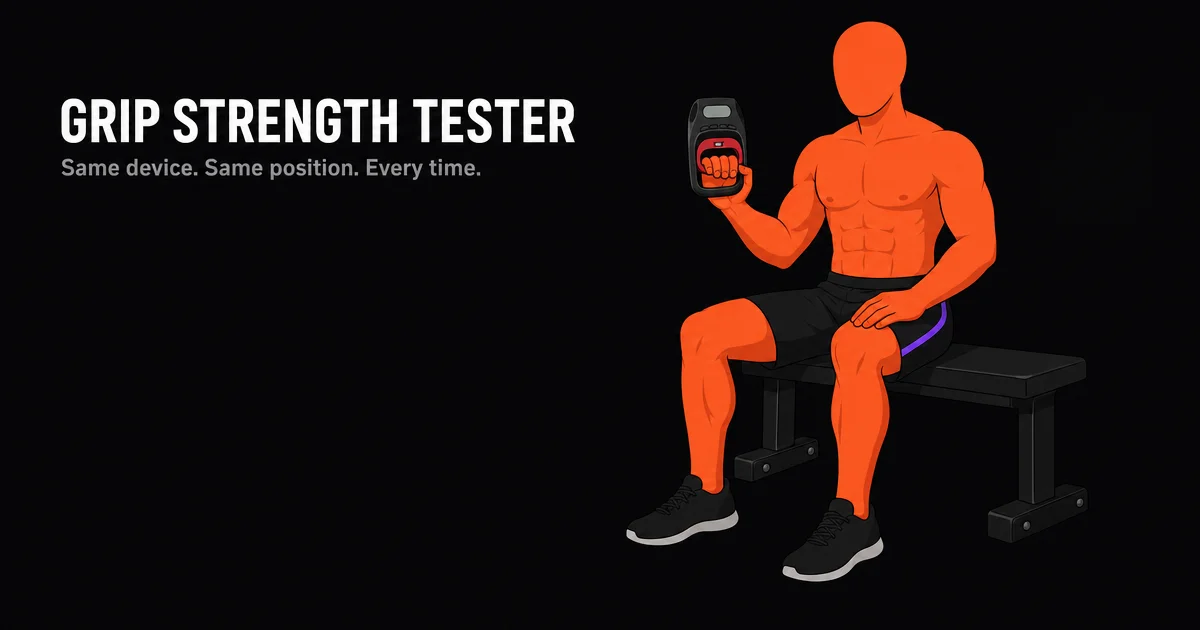
"Grip strength tester" and "hand dynamometer" are two names for the same device. You hold it in one hand, squeeze the handle as hard as you can for a few seconds, and it reports the peak force in kilograms or pounds. The handle barely moves, so what you're measuring is an isometric crush grip: the hardest single squeeze your hand can produce.
That makes it a narrow tool. It doesn't measure support grip (holding on while gravity pulls something out of your hand, which is what gives out first in a long hang or a heavy carry) or pinch grip. A big squeeze number tells you little about how long you can hang from a bar; the dead hang guide covers that side.
Think of it as a ruler, not a training tool. You train with grippers, bars, and weights, then come back to the ruler every few weeks to see whether the work moved the number.
Key takeaways
- A grip strength tester measures one thing: your peak squeeze. Hangs, carries, and pinch need their own tests.
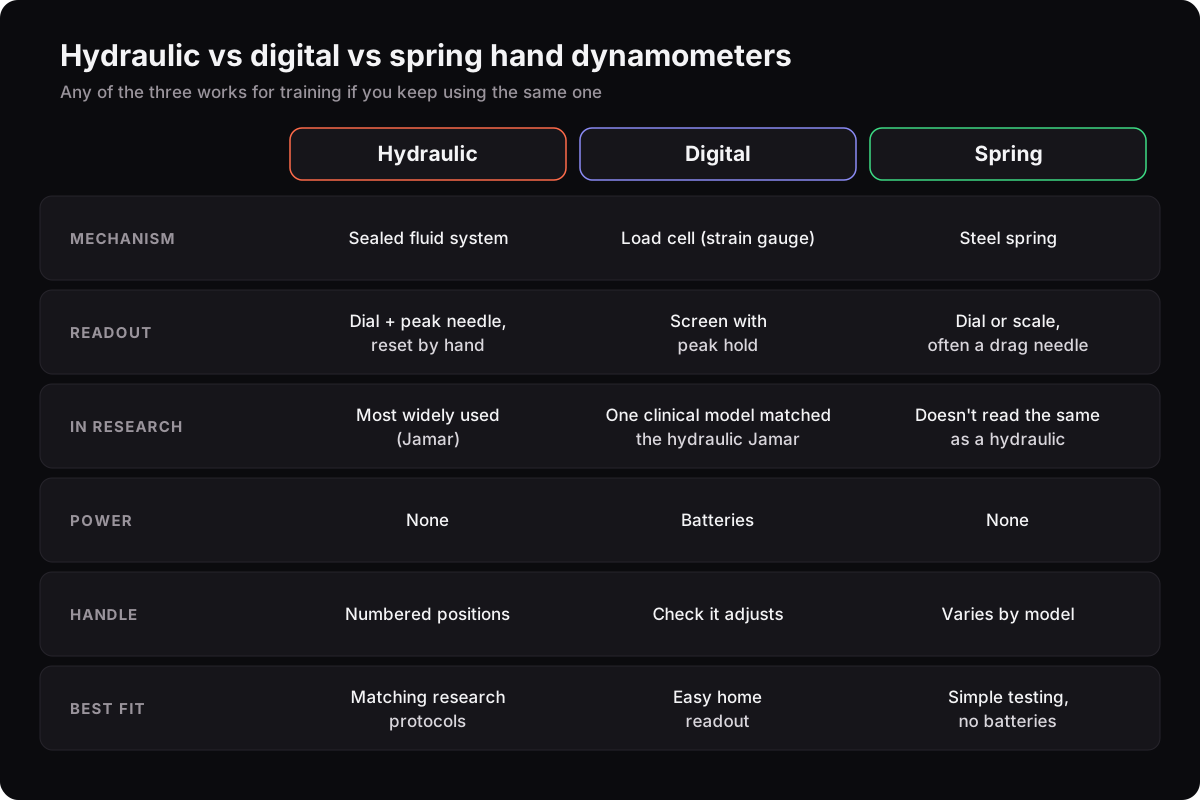
- Hydraulic (Jamar-style) testers are the instrument most research is built on. Digital models are easier to read. Spring models are simple and need no batteries.
- Readings from different devices aren't automatically interchangeable, so a home number and a clinic number can differ.
- Consistency matters more than the brand: same device, same position, same handle setting, same scoring rule.
- Record the left and right hands separately. One blended number hides the gap between them.
Hydraulic, digital or spring: which hand dynamometer type?
Three designs cover almost every tester you'll find. They differ in how they sense force and how they show it, and that decides who each one suits.
Hydraulic
Squeezing the handle pushes on a sealed fluid system, and a dial shows the force, with a second needle that stays at your peak. No batteries. Reset that needle to zero before every squeeze, or you'll read your last attempt. The Jamar hydraulic is the most widely used grip instrument in research (Roberts et al., 2011), so it's the right pick if you want your test to match how published studies were run.
Digital (load cell)
A load cell turns force into an electrical signal and a screen shows the number. Most models have a peak-hold mode that freezes your maximum, and many switch between kg and lb. They need batteries. A digital tester suits home use: there's no dial to misread and no needle to forget to reset.
Spring (analog)
A steel spring resists the squeeze, and a mechanical dial or scale shows how far you've compressed it. Spring testers are simple and need no power. Treat their numbers as their own scale. The large international norms review had to convert between dynamometer types before it could pool data (Tomkinson et al., 2025).
A deeper side-by-side, grip strength testers compared, is coming as its own guide.
Are hand grip dynamometers accurate?
"Accurate" hides two questions. Does the tester read the true force? And does it give you the same number when nothing has changed? For training, the second one matters more, because you're comparing yourself with yourself.
On the first question, the research reference is the hydraulic Jamar. A review of grip measurement in clinical and epidemiological studies found it was the most widely used instrument, with established test–retest and rater reliability. The same review found wide variation in how studies used it and scored it: maximum or mean, one to three attempts, either hand or the dominant hand only (Roberts et al., 2011). The inconsistency was in the protocols, not the device.
The protocol itself repeats well when you stick to it. In the healthy-adult studies collected by the Shirley Ryan AbilityLab's rehabilitation measures database, test–retest reliability ranged from ICC 0.81 to 1.0 (Shirley Ryan AbilityLab). ICC, the intraclass correlation, is a 0-to-1 score for how closely repeated measurements agree: the closer to 1, the more repeatable the test.
Whether two devices agree depends on the pair:
- Hydraulic vs its digital sibling. In 35 healthy young adults, the hydraulic Jamar and the digital Jamar Plus+ both showed excellent reliability (ICC 0.96–0.98) and agreed closely. The authors concluded the two can be used interchangeably. A Biodex system agreed poorly with both, with limits of agreement as wide as ±73% (dos Santos et al., 2025).
- Hydraulic vs a different design. In 40 healthy adults, a digital Jamar and a Martin Vigorimeter, a squeeze-bulb device, were each reliable from one session to the next (ICC 0.85–0.97 across all three devices). But the Vigorimeter's readings drifted from the hydraulic Jamar, especially at low and high values, and the authors cautioned against using the devices interchangeably (Gränicher et al., 2024).
Both are small studies of healthy adults, so don't stretch them to every population.
Both studies tested clinical models. A consumer tester hasn't necessarily been checked against anything, which is why a seller's stated calibration standard is worth looking for. Clinical guidance is to calibrate annually, or more often with daily use (Shirley Ryan AbilityLab). A home tester rarely gets that.
So treat your tester as your own yardstick. A reading from it won't necessarily match the clinic's, but if you test the same way every time, a change in your number is a change in your grip.
What to look for when buying a grip strength tester
Look for a tester that won't run out of scale and lets you repeat the same test for years:
- Capacity comfortably above your best squeeze. If the strongest person who'll use it can hit the ceiling, the test stops telling you anything.
- An adjustable handle with numbered positions. Standard protocols use a set handle position. You want to pick one and come back to it every time.
- Peak hold. On a digital tester, a peak-hold mode freezes the maximum. On an analog one, look for a peak needle you can reset by hand.
- A kg/lb switch and a readable display. Pick the unit your norms and your log use, and keep it.
- Build quality and a stated calibration standard. A seller who says how the device was calibrated gives you something to check. One who only says "professional" or "high precision" doesn't.
Be skeptical of "tester plus trainer" kits that bundle a dynamometer with grippers and finger bands. The extras don't make the measuring part better, and they blur the line between testing and training. Judge the dynamometer on its own.
The standard grip test in five steps
The clinical protocol takes about five minutes (Shirley Ryan AbilityLab):
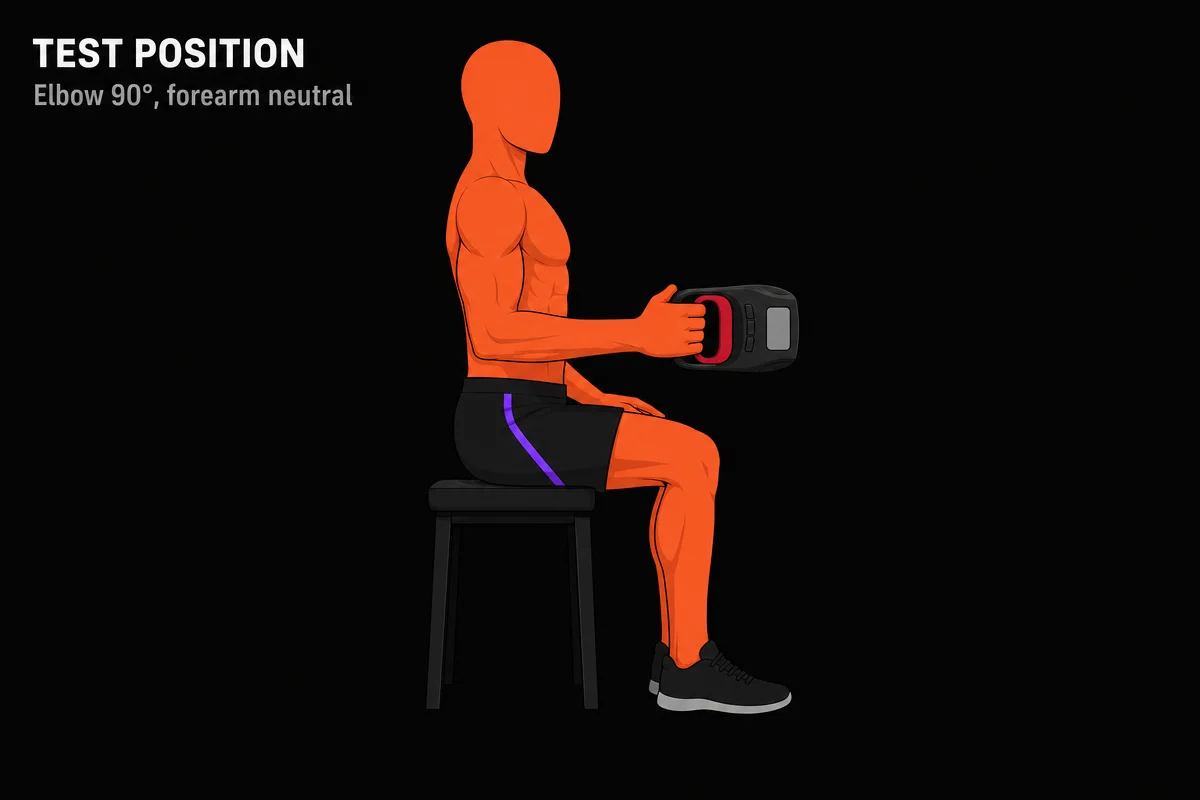
- Sit upright, with your hips and knees at about 90°.
- Upper arm against your side, elbow bent to 90°.
- Forearm neutral, thumb pointing up, wrist straight, arm unsupported.
- Handle in the second position, the standard setting on hydraulic testers.
- Squeeze as hard as you can for about 3 seconds; three trials per hand, with about a minute of rest between them.
The clinical score is the mean of the three trials; the published norms use the best of three. Pick one and never switch.
Reading the dial gets its own guide, how to use a hand dynamometer (coming soon). You can also test grip strength at home without a dynamometer.
Comparing your reading with norms
A single number only means something next to people like you. Compare it with average grip strength by age, which sets out percentiles for men and women in five-year age groups, or drop it into the grip strength percentile calculator.
Those norms come from an international review of 2,405,863 adults from 69 countries and regions (Tomkinson et al., 2025). The authors adjusted every study to one reference protocol: a hydraulic dynamometer, seated, elbow flexed, three squeezes per hand, best result. If you test differently, your percentile moves. Scoring the mean of three instead of the best pulls your number down a little. A different device type can shift it too.
So compare like with like. If you want to place yourself on the published norms, test the reference way: seated, elbow bent, best of three. If you only care about your own progress, any fixed protocol works. A plain verdict on your number, what is a good grip strength, is coming as its own guide.
Are grip strength testers worth it?
A tester is worth buying if:
- grip limits your training or your sport, and you want to know whether the extra work is paying off;
- you want to see the gap between your left and right hands as a number, not a feeling;
- you're coming back to training after a hand or wrist problem and want numbers to share with your physio or hand therapist.
It isn't worth it for a one-off curiosity check. A max dead hang, a rated gripper, or a timed pinch hold will tell you roughly where you stand for nothing. The guide to testing grip strength at home walks through all three.
Know the downsides before you buy:
- It's sensitive to setup. A different body position or handle setting changes the reading. The clinical guidance is blunt about it: change the position and you change the grip strength.
- Numbers don't transfer between devices, as the accuracy section showed.
- It only measures crush grip. Support and pinch strength can improve without the dynamometer number moving.
How to track grip strength tests over time
A test only helps if the next one is comparable.
- Keep everything fixed: the same tester, position, handle setting, and scoring rule, at roughly the same time of day.
- Write the setup down once. Note the device, the handle position, and whether you score the mean or the best, and keep that note with your results. Six months from now you won't remember.
- Test fresh. Don't test straight after a grip session, when your forearms are already tired.
- Retest every few weeks, not every day. Strength takes weeks to build, so a daily test mostly measures how you feel that day.
- Judge the trend. One good or bad test is a data point. Three or four in a row are a direction.
- Record each hand on its own. If you average both hands into one number, a weaker side can hide inside a decent total. The guide to grip strength symmetry covers what a normal left–right difference looks like.
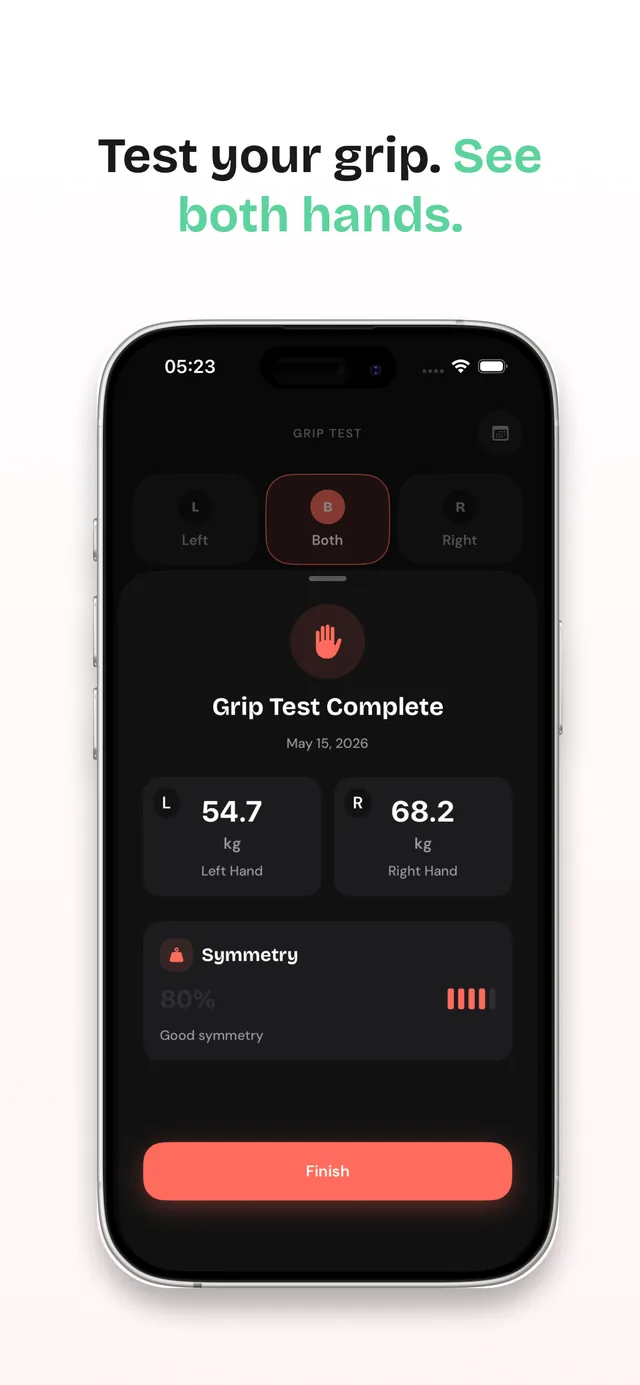
MrGripper's dynamometer grip test is built for that routine. Pick left, right, or both hands, then type in the reading from whatever tester you own, in kg or lb. The app keeps each hand separate and gives you a left–right symmetry score.
It doesn't pair with or read from any device. You enter the number yourself, which is why it works with any tester; more on that in grip strength app without a Bluetooth dynamometer. If you'd rather log tests next to your training, the app's catalog has a Max Squeeze exercise for dynamometer attempts. Dynamometer tests and per-hand tracking are free, with a 30-day history window. Full history is part of MrGripper Pro.

Log every grip test, per hand
Grip Strength: MrGripper is free on the App Store for iPhone, iPad, Mac, and Vision Pro. Enter readings from any dynamometer, keep the left and right hands separate, and watch the symmetry score.
Grip strength tester FAQ
What device can I use to test my grip strength?
A hand dynamometer, also sold as a grip strength tester. You squeeze it as hard as you can and it shows your peak force in kilograms or pounds. Hydraulic, digital, and spring models all work for tracking your own progress, as long as you stick with one device and test the same way every time.
What is the most accurate grip strength tester?
We found no study that ranks consumer models. Among clinical devices, the hydraulic Jamar is the most widely used reference in research. In one small 2025 study of healthy young adults, its digital sibling, the Jamar Plus+, agreed closely enough to be used interchangeably, while a different system did not. For your own training, a tester you use the same way every time matters more than the brand.
Do grip strength testers work?
Yes, for what they measure: your peak squeeze. Clinical dynamometers give consistent readings when the protocol stays the same, and a home tester can be your own yardstick if you use it the same way every time. Readings from different devices aren't automatically comparable, so don't mix numbers from your tester, a gym's, and a clinic's in one log. Use one device and the same protocol.
Are grip strength testers worth it?
They're worth it if grip limits your training or sport, if you want to see the gap between your left and right hands as a number, or if you're returning to training and want readings to share with your physio. For a one-off curiosity check, the free at-home tests (a dead hang, a gripper close, or a pinch hold) are enough.
What are the downsides of using a hand grip dynamometer test?
It's sensitive to setup: change your body position or the handle setting and the reading changes. Devices don't always agree, so your number may not match a clinic's. It only measures crush grip, not support or pinch strength. And a single test is just one data point. Keep the protocol fixed and judge the trend over several tests.
How to test grip strength without a device?
Use a test you can repeat. Time a max dead hang from a pull-up bar, find the heaviest rated hand gripper you can fully close, or time how long you can pinch two smooth weight plates together. None of them converts to kilograms, but each gives you a number to beat. Our at-home testing guide covers all three.
Sources
- Standard test position, handle setting, trials, rest, scoring, retesting on the same instrument, and calibration: Hand-held Dynamometer/Grip Strength. Shirley Ryan AbilityLab, Rehabilitation Measures Database.
- The Jamar as the most widely used grip instrument, and variation in protocols and scoring: Roberts HC, et al. A review of the measurement of grip strength in clinical and epidemiological studies: towards a standardised approach. Age Ageing. 2011;40(4):423–429.
- Agreement between the hydraulic Jamar, the digital Jamar Plus+, and a Biodex system: dos Santos GMX, et al. Test-retest reliability and concurrent validity of three different handgrip dynamometers (Jamar, Jamar Plus+ and Biodex) in healthy young adults. Hand Ther. 2025;31(1):29–44. 35 healthy young adults.
- Agreement between the hydraulic Jamar, a digital Jamar, and the Martin Vigorimeter: Gränicher P, et al. Accuracy and Reliability of Grip Strength Measurements: A Comparative Device Analysis. J Funct Morphol Kinesiol. 2024;9(4):274. 40 healthy adults.
- International norms and the reference test protocol they are harmonised to: Tomkinson GR, et al. International norms for adult handgrip strength: A systematic review of data on 2.4 million adults aged 20 to 100+ years from 69 countries and regions. J Sport Health Sci. 2025;14:101014.